The Environmental Evolutionary Genomics Initiative operates from a suite of world-class molecular facilities at the University of Adelaide, enabling us to perform cutting-edge genomics research on a diverse variety of sample types, from 400,000 year old cave sediments through museum specimens and modern plant tissues.
Ancient DNA Facility

Our purpose-built ancient DNA facility is designed to minimise contamination risk when working on samples containing ultra-low copy number and highly-degraded DNA. Key features include physical isolation from other molecular laboratories (located off campus in the State Herbarium building), positive air pressure, sterile HEPA-filtered air supply and nightly UV irradiation. The facility is also a registered transitional facility, allowing samples from overseas to be imported, stored and analysed securely.
Historical DNA Laboratory
The Historical DNA Laboratory is designed for working on specimens with DNA that is degraded, but not to the extent of being truly ancient DNA. These include museum and herbarium specimens, environmental samples that are <200 years old, and historic or fragmentary forensic materials. The laboratory is physically isolated from other molecular laboratories, has positive air pressure, and users maintain strict protocols around cleaning and use of appropriate PPE.
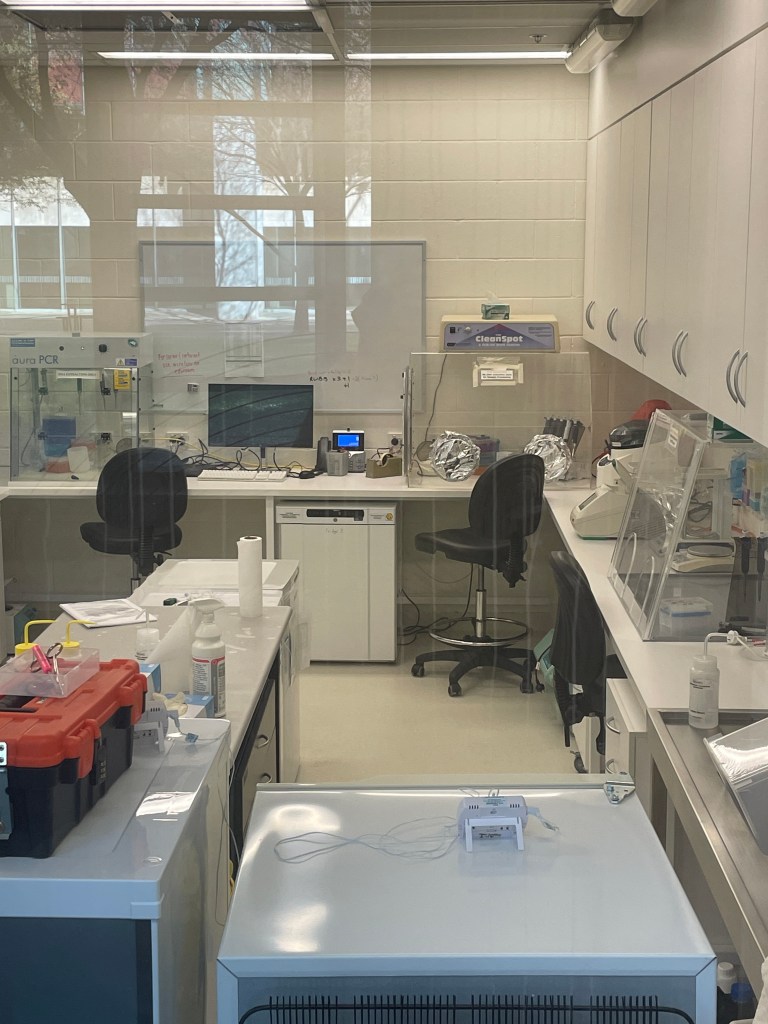
Advanced DNA, Identification and Forensic Facility (ADIFF)

The Advanced DNA, Identification and Forensic Facility (ADIFF) is used for applying cutting edge DNA technology to a broad range of biological samples. These include degraded human remains, plant (including timber) and animal material through to sensitive environmental samples. The facility has positive air pressure, a unidirectional workflow, and strict operational protocols that are designed to minimise the risk of sample contamination.
South Australian Facility for Molecular Ecology and Evolution (SARFMEE)
The South Australian Regional Facility for Molecular Ecology and Evolution (SARFMEE) provides a central resource for South Australian researchers using molecular genetic techniques in evolutionary and ecological studies. The Facility features high throughput generation of molecular genetic data through automated liquid-handling robotics and efficient access to next generation sequencing and bioinformatics services.

 Exploring - INNOVATING -ADVANCing